If you opened ChatGPT, Perplexity, or Google today and typed “best web designer in Mumbai” or “how should an NGO build credibility online,” chances are you didn’t scroll through ten blue links. You got an answer. A clean, summarised, ready-to-act-on answer.
That single shift in user behaviour is quietly rewriting the rules of search, and most small businesses haven’t caught up yet. Welcome to the era of Generative Engine Optimization, or GEO, the discipline that decides whether your business gets mentioned inside an AI’s answer, or stays invisible behind it.
At FreelanceWala, we work with founders, startups, and NGOs every week, and the same question keeps coming up: “Is traditional SEO dead?” The honest answer is no. But it is no longer enough on its own. Here’s what GEO really means, and what you should be doing about it before your competitors figure it out.
What Exactly Is Generative Engine Optimization?
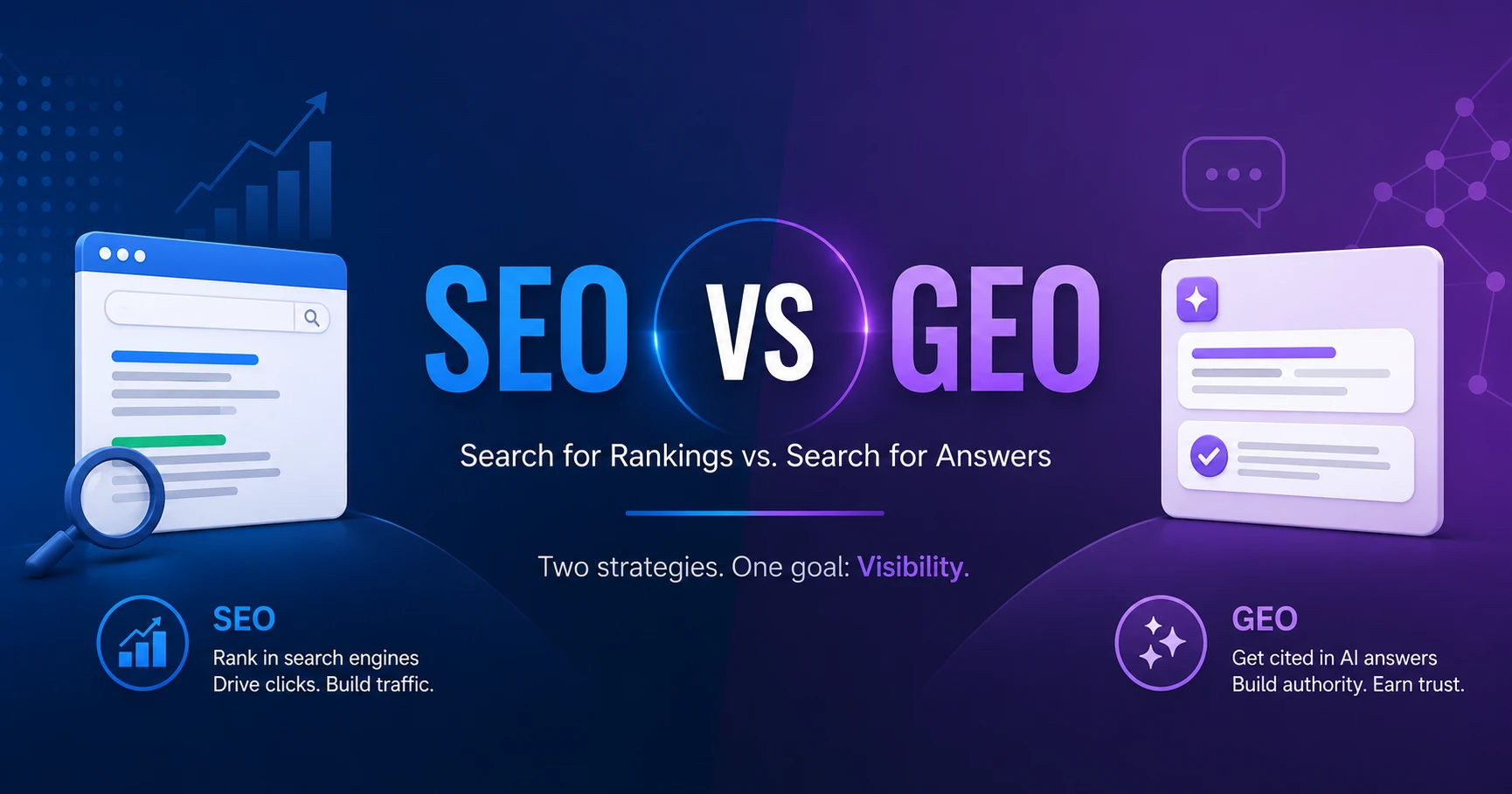
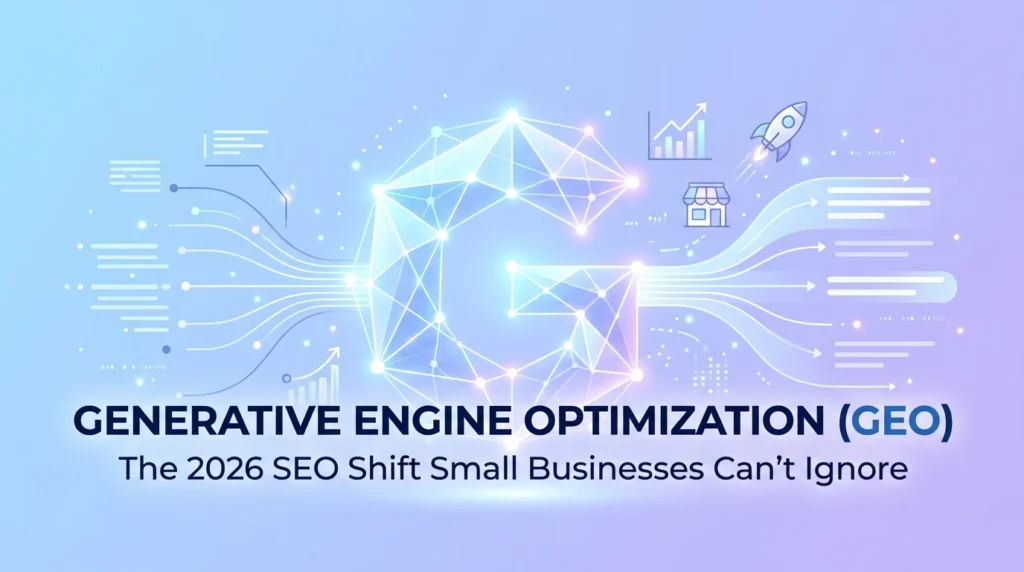
Generative Engine Optimization is the practice of structuring your website and content so that AI-powered search engines like ChatGPT Search, Google AI Overviews, Perplexity, and Gemini can read it, trust it, and cite it inside their answers.
Think of traditional SEO as competing for a spot on a shelf in a library. GEO is competing to be the source the librarian quotes when a visitor asks a question. Same library, very different game.
Google’s AI Overviews now appear on a significant portion of search results, often pulling in summarised answers before users ever see a clickable link. ChatGPT alone has grown to more than 800 million weekly users in just over a year. If your business isn’t structured to be referenced by these systems, you are losing visibility you don’t even know you had.
This shift is part of a larger transformation we recently explored in our piece on How AI and Automation Are Shaping the Future of Web Development.
Why GEO Matters More for Small Businesses Than Big Brands
There’s a common assumption that AI search favours large corporations. The reality is the opposite, and it’s good news if you are a small business or an NGO.
AI engines are extremely good at general questions. They struggle with specific, local, or nuanced ones. “What is digital marketing” is a generic query. “How can a Mumbai-based NGO build a donor-friendly website on a small budget” is a niche question, and that is exactly where smaller players can win citations. Your specificity is your competitive advantage.
Equally, AI models look for trust signals like real authorship, transparent expertise, customer reviews, and consistent brand mentions across the web. A focused small business with a clear voice and genuine case studies can earn citations faster than a faceless corporate site stuffed with generic content. This is also why we always emphasise that a well-designed website builds customer trust instantly that same trust is now being read by AI, not just humans.
The 5 Things You Should Start Doing This Month
You don’t need to overhaul your entire site to begin. Start with these five practical steps.
1. Write direct answers, then add context. AI engines extract the first clear sentence under a heading. So if your page asks “What is GEO?”, the next line must answer it plainly, in one sentence, before you elaborate. Lead with the answer, follow with the story.
2. Add structured data (schema markup). FAQ schema, Article schema, LocalBusiness schema, and Organization schema act like name tags for AI crawlers. They tell the model what your page is, who wrote it, and why it should be trusted. You can validate your structured data using Google’s Rich Results Test. Most WordPress users can add this through plugins like Rank Math or Yoast in under thirty minutes.
3. Build a “human moat” around your content. AI-generated filler is flooding the internet, and search engines are responding by rewarding what they can verify is real. Add author bios with credentials, a clear “About” page, real photographs, named case studies, and short founder videos where possible. These are the proof-of-life signals that separate trusted sources from background noise. If you’re unsure where your site stands today, our guide on why your website’s first impression matters more than you think covers the basics.
4. Stop chasing keywords. Start owning topics. Instead of writing twenty thin articles on twenty keywords, write one genuinely useful pillar piece on a topic your business is qualified to discuss. AI engines reward depth and coherence, not repetition. Google’s own E-E-A-T guidelines now sit at the heart of how content quality is judged.
5. Check that AI crawlers can actually reach you. This is the step most businesses miss. Many sites unknowingly block AI bots in their robots.txt file or through Cloudflare defaults. Check whether crawlers like GPTBot, PerplexityBot, and Google-Extended are allowed access. OpenAI’s documentation on GPTBot gives the exact directives you need. If they can’t read your site, they can’t cite it.
What This Means for NGOs Specifically
For NGOs, GEO is more than a marketing tactic. It is a credibility multiplier. When a potential donor asks an AI “which NGOs in India work on child education and have transparent financials,” the organisations that have invested in clear content, verified information, and well-structured impact reports will be the ones surfaced in the answer.
That is a direct path to donor trust, grant visibility, and volunteer reach, often without spending a rupee on paid ads. We covered this opportunity in detail in our recent blog on the Top 5 Digital Trends and Freelance Strategies Empowering NGOs in 2026.
Traditional SEO Is Not Dead, It’s the Foundation
Here’s the part many “GEO experts” on LinkedIn won’t tell you. Traditional SEO still drives roughly thirty-four times more traffic than AI-driven search for most websites, according to WordStream’s 2026 Small Business Website Trends Report. Strong technical SEO, fast page speed, mobile responsiveness, and quality backlinks remain non-negotiable. GEO doesn’t replace these. It sits on top of them.
If your foundation is shaky, no amount of GEO will fix it. That’s why we often start client engagements with a hard look at why a website may not be generating leads in the first place and only then layer GEO strategies on top.
The businesses that win in 2026 will be the ones who treat SEO as the foundation and GEO as the upper floor, designed for a new kind of visitor: the AI agent searching on a human’s behalf.
The Bottom Line
Search is no longer about ranking higher. It is about becoming the answer.
If your website is still optimised only for keywords and backlinks, you are competing for yesterday’s traffic. If you start preparing for GEO now, while most of your competitors are still debating whether it matters, you build a quiet, compounding advantage that will pay off every single time someone asks an AI about your industry.
At FreelanceWala, this is exactly the work we help small businesses, startups, and NGOs prepare for through our SEO and digital services. Because being seen in 2026 won’t just be about being online. It will be about being cited.
Want to see how your site stacks up for GEO readiness? Book a free consultation with our team and we’ll walk you through it.